Here's the honest answer: true acne scars don't respond much to creams or serums, because the damage sits below the surface where products can't reach. What does work is a treatment that gets your skin to rebuild its own collagen, and for most people that means microneedling, ideally with radiofrequency (RF). Plan on 3 to 6 sessions and a few months before you see the full result.
Before any of that, though, it's worth figuring out whether you have a scar or a mark. They look similar in the mirror, and they're treated in completely different ways.
Is it a scar or a mark?
A lot of what people call acne scars are actually marks. If a spot is flat and brown, it's usually post-inflammatory hyperpigmentation. If it's flat and pink, red or purple, it's usually post-inflammatory erythema. Neither one has changed the texture of your skin, and both tend to fade over time, faster with daily sunscreen and the right products.
A true scar changes the texture. It's a dip, a pit or a raised bump.
Here's a quick way to tell. Stand next to a window so the light hits your face from the side, then run a fingertip over the area. If you can see a shadow or feel an edge, it's a scar. If the skin feels completely smooth, it's a mark.
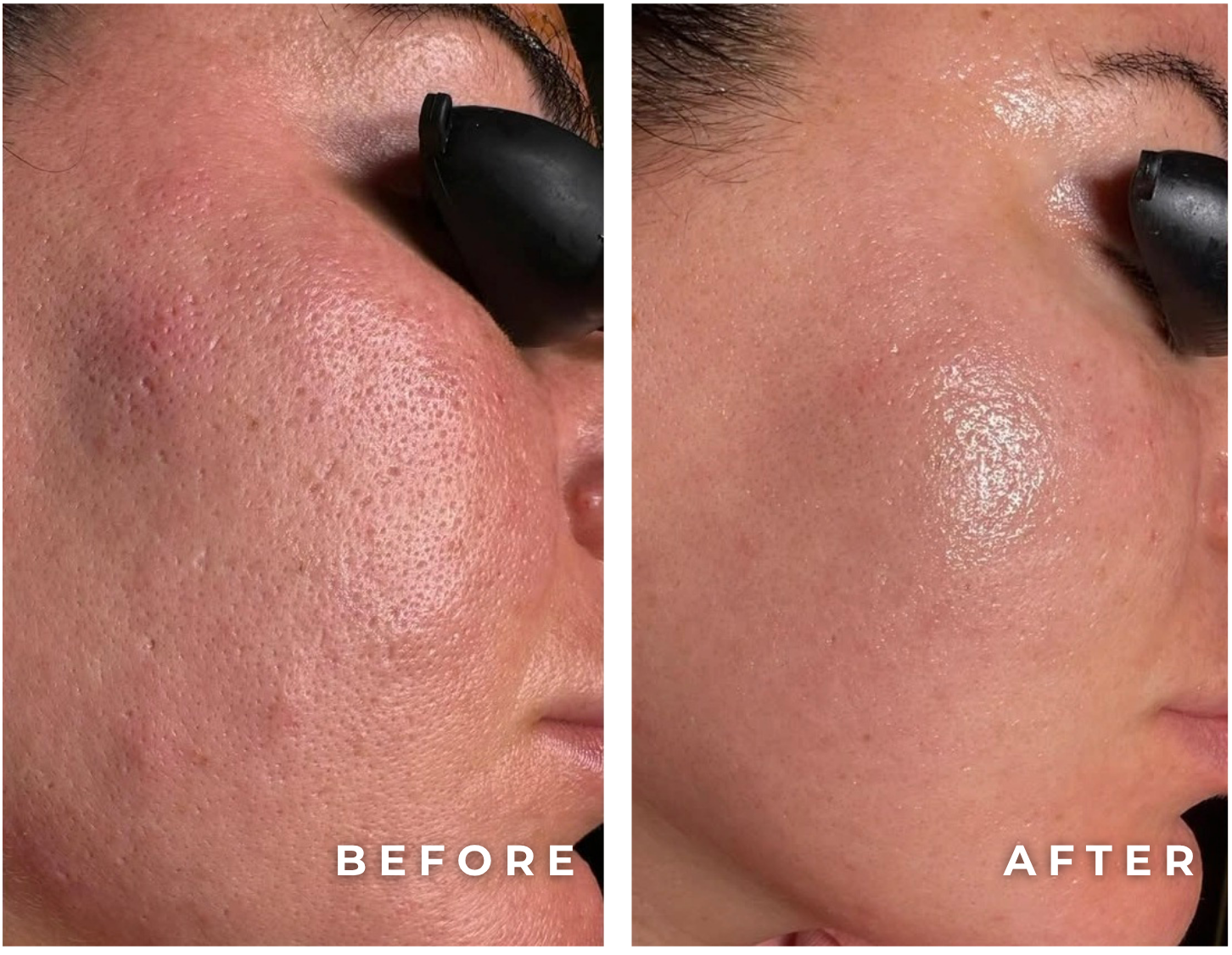
Acne scars before and after Microneedling RF at Luxe Esthetic Studio in Dothan, AL
The main types of acne scars
Most people have a mix of these, which is a big reason one product rarely fixes everything.
Rolling scars are wide and shallow with soft edges. They make skin look wavy or uneven, especially under overhead lighting.
Boxcar scars are wider pits with sharp edges, usually on the cheeks and temples. Ice pick scars are narrow and deep. They can look like a large open pore.
Raised scars are firm bumps that sit above the skin. They're more common on the jawline, chest and back.
The first three are called atrophic scars, meaning the skin lost collagen while the breakout healed. That's the part we need to rebuild.
Why creams and at-home tools don't fix scars
Retinoids, acids and vitamin C are worth using. They smooth surface texture and help marks fade faster. What they can't do is fill a pit that sits in the deeper layer of your skin.
At-home derma rollers are a similar story. The needles are too short to reach where scars form, and they're hard to keep sterile, so you take on the risk of irritation and infection without getting the remodeling you're after.
What actually works for indented acne scars
The treatments that work all do the same basic thing. They cause a small, controlled injury so your skin responds by making new collagen.
Microneedling does this with very fine needles that create tiny channels in the skin. On its own, it helps mild scarring and texture. When RF is added, those channels let heat reach the deeper layers too, which pushes collagen and elastin production further. In plain terms, you get more remodeling and more tightening from each session.
RF microneedling tends to do best on rolling and boxcar scars. Deep ice pick scars can soften but are the most stubborn type, and we'll tell you honestly at your consultation what's realistic for yours.
It's also a good fit for a wider range of skin tones. RF doesn't rely on targeting pigment the way many lasers do, so it's generally considered a lower-risk option for medium and deeper skin.
What treatment looks like at Luxe Esthetic Studio
Here's what to expect with Microneedling RF at Luxe Esthetic Studio:
Number of sessions: Most people need 3 to 4 sessions, spaced 4 to 6 weeks apart. Deeper scars usually take 3 to 6.
When you'll see a change: Most people notice improvement after the second session. Results keep building for about three months after your last one, because that's how long new collagen takes to form.
Comfort: Numbing cream goes on first. Most people describe it as warm and prickly rather than painful.
Downtime: Your skin will be red right after, and that usually settles within a few hours. You might still be a little pink the next morning, but most people go back to work the next day.
Aftercare: No makeup for 24 hours and no direct sun for 48 hours.
Get active breakouts under control first.
Microneedling isn't done over active, inflamed acne. And if you're still breaking out, new scars keep forming while you're treating the old ones.
So if you're still getting breakouts, start there. Our Acne Membership Program is built to clear active acne first, and scar treatment comes after your skin has settled. If you've taken isotretinoin (Accutane) in the past year, let us know at your consultation so we can plan the right timing.
Common questions about acne scars
Do acne scars go away on their own?
Flat marks usually fade on their own over several months. True indented scars generally don't, and they can look more noticeable as you get older and your skin naturally loses collagen.
How long do results last?
The collagen you build is your own, so results are long-lasting. Your skin will keep aging normally, and some people choose a single maintenance session down the road.
Can I treat acne scars and dark spots at the same time?
Often, yes. We'll look at both at your consultation and tell you what order makes the most sense for your skin.
Not sure what kind of scars you have?
That's exactly what the consultation is for. Book a free skin consultation and we'll look at your skin in person, tell you which type of scarring you're dealing with, and let you know whether Microneedling RF is the right next step or whether we should calm your breakouts first.